

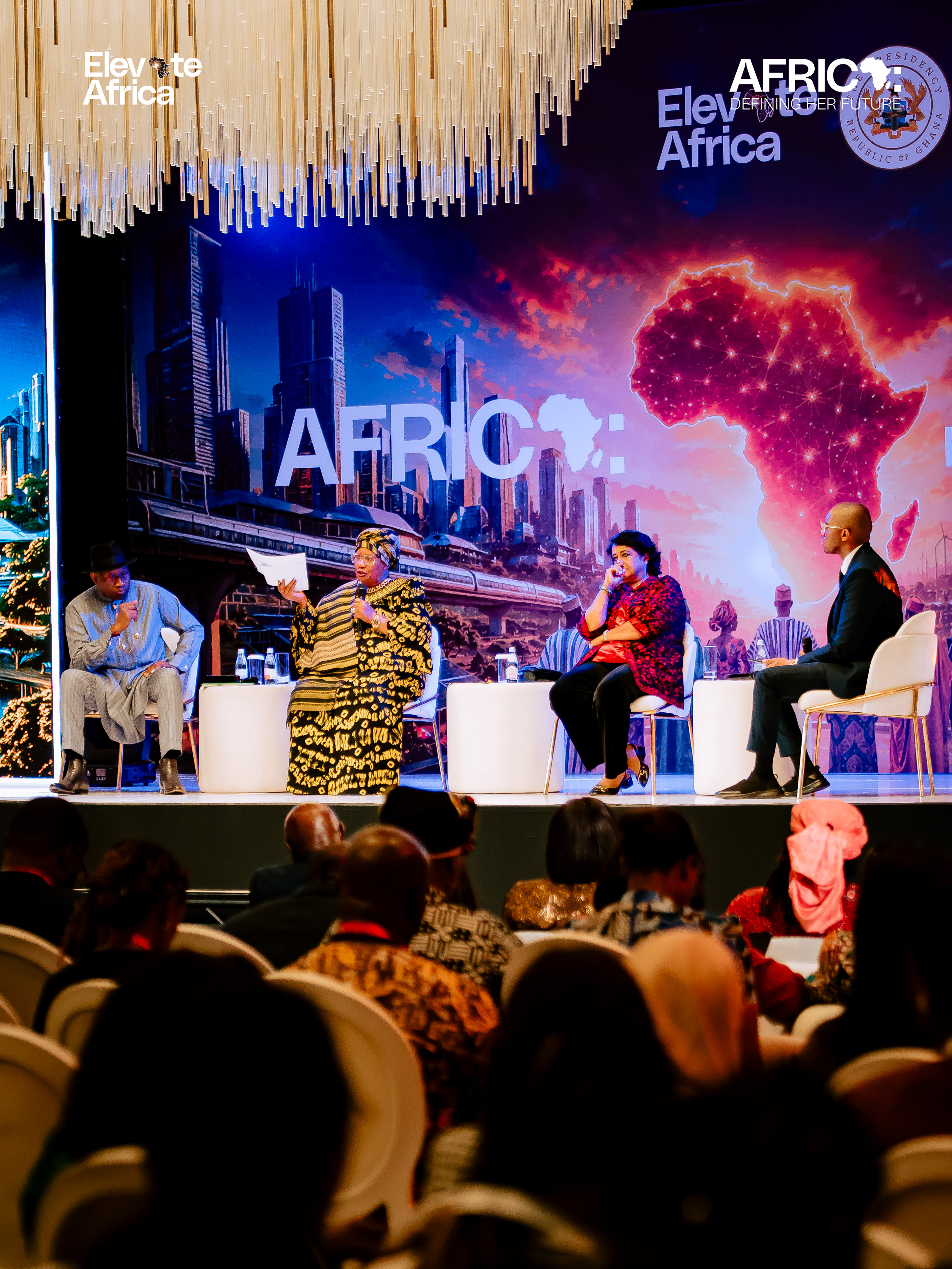
A question hung over the room at this year's Elevate Africa Convening in Accra: how does Africa move the push for slavery reparations from recognition and resolutions to meaningful action?
It was the central challenge of the Presidential Roundtable at the Elevate Africa Convening 2026, held in the Ghanaian capital under the theme "Africa: Defining Her Future." Moderated by the BBC's Focus on Africa presenter Waihiga Mwaura, the discussion brought together President Julius Maada Bio of Sierra Leone and three former presidents: Goodluck Jonathan of Nigeria, Joyce Banda of Malawi and Ameenah Gurib-Fakim of Mauritius for a candid conversation on what reparations for the transatlantic slave trade could look like, and who should ultimately pay.
The timing gave the debate its urgency. In March 2026, the United Nations General Assembly adopted a Ghana-led resolution recognising the trafficking and enslavement of Africans as the gravest crime against humanity, with 123 member states voting in favour. But the leaders gathered in Accra acknowledged that the hardest work lies ahead.
"Difficult, But It Must Be Done"
The panel opened by confronting the arithmetic of the UN vote itself. Former President of Mauritius, Gurib-Fakim noted that the countries that voted against the resolution or abstained were "precisely those who have benefited from slavery", and that whether they will ever pay is another matter entirely.
She pointed to history as a warning about how long justice can take. It took nearly a century for Belgium to apologise for the millions who died in the Congo, she said, and Germany only recently apologised for the genocide in Namibia. Her prescription for the meantime is to honour the victims through education, because in an era of artificial intelligence, this history can too easily be erased.
"We have to keep on educating, keep on writing, keep on teaching our kids true history," she said.
A United Front and an Honest Mirror
Former President Goodluck Jonathan argued that the struggle is about more than money. "It's not just about the financial rewards alone, but the consciousness it is bringing to our people," he said. Even the church was involved in the slave trade, he noted, and many at the time did not even know it was a criminal act.
But he also held up a mirror to the continent. He reminded the audience that Africans themselves were induced to sell their brothers and sisters into slavery, and asked whether today's leaders, who move national wealth abroad while their countries fail to develop, are behaving any differently. His call was for the African Union to take up the issue so that African leaders can advance a common position.
Climate Justice, Debt and the Security Council Door
President Maada Bio widened the lens beyond slavery, arguing that today's injustices must form part of any conversation about repair. African nations contribute so little to climate change yet bear its costs, he said, while wealthy nations "continue to man the gate," blocking access to climate finance.
He pointed to the debt burden squeezing the continent, with many African governments spending 60 to 70 percent of their budgets on debt servicing, and to Africa's absence from the UN Security Council, where 1.4 billion people remain locked out of a room whose business concerns mostly African issues.
"We have been knocking at that door politely," he said. "We continue to shout."
Who Should Benefit?
Former Malawi President, Joyce Banda, a long-standing champion of pan-African climate justice, said Africa deserves reparations, but was frank about the complications. The diaspora asks: reparations to whom? To those who crossed the Atlantic, or to those who remained in Africa?
She recalled watching a village in Malawi swept away by flooding. She said, "The first time in my life to see a whole village swept away, together with the people and the children", adding that those who polluted the climate must compensate Africans. According to her, her organisation has already planted two million trees and distributed 200,000 cook stoves in partnership with Western funders, proof, she argued, that practical reparatory action is possible even while the broader debate continues.
Finally, Gurib-Fakim posed perhaps the roundtable's most provocative question: is slavery really over? Children still work in mines in the Democratic Republic of Congo to feed global supply chains, she noted, and consumers hold the power to demand slave-free products.
Watch the Full Conversation
The roundtable, recorded at the Elevate Africa Presidential Roundtable in Accra, aired on the BBC's Focus on Africa. It followed the adoption of the Accra Declaration of Commitment by participating leaders, which called for the recognition of slavery's enduring consequences, the return of ancestral remains and cultural property, and formal apologies where appropriate.
The full 26-minute discussion is available to watch on BBC News Africa. https://www.youtube.com/watch?v=33oO16K7PWA